
Forecast accuracy tracking (FACT)
Historical forecasts are preserved and compared against what WeatherXM stations actually observed on the ground, allowing Forecast Accuracy Tracking to rank model performance by place, variable, and forecast horizon.
How forecast accuracy tracking operates
Most weather providers serve a single forecast without disclosing historical errors. WeatherXM ingests and stores major numerical weather models, archives each forecast at issuance, and continuously scores their predictions against physical ground-truth stations.
Historical forecast archive
We preserve model predictions at every run cycle (00Z, 06Z, 12Z, 18Z) for lead times from 1 to 10 days. Once issued, forecasts are immutably archived so accuracy can be audited retrospectively.
Ground-Truth Comparison
When the target forecast hour arrives, we compare the archived predictions against verified ground observations from WeatherXM stations located in that exact microclimate.
Continuous model ranking
Statistical metrics—including Mean Absolute Error (MAE), Root Mean Square Error (RMSE), and Continuous Ranked Probability Score (CRPS)—are calculated per model, variable, and geographic cell.
Global model performance sample against ground truth

Illustrative MAE temperature error tracking across forecast lead times (Day 1 through Day 7). Live cell-level accuracy rankings and custom verification reports are available via the WeatherXM Pro API.
Models Evaluated by FACT
FACT continuously audits major global numerical weather prediction (NWP) models, regional high-resolution models, and emerging machine-learning weather foundations.
European Centre Model
Global medium-range model benchmarked across 1–10 day horizons for 2m temperature, wind, and precipitation.
Global Forecast System
Operational global model from NOAA evaluating North American and international microclimates.
German Weather Service
Global and regional non-hydrostatic atmospheric model evaluated for European terrain performance.
Neural weather models
Data-driven AI weather models evaluated against real surface observation stations to measure physical realism.
Hyperlocal station forecasts (HSF)
Global weather models compute on coarse 9–25 km grid squares, missing valleys, hills, urban canyons, and coastal thermal boundaries.
WeatherXM’s Hyperlocal Station Forecast (HSF) combines historical ground observations with FACT model accuracy rankings. Machine learning algorithms correct systematic biases and produce tailored point-forecasts for individual station locations.
Hyperlocal point forecast UI
1-Hour Resolution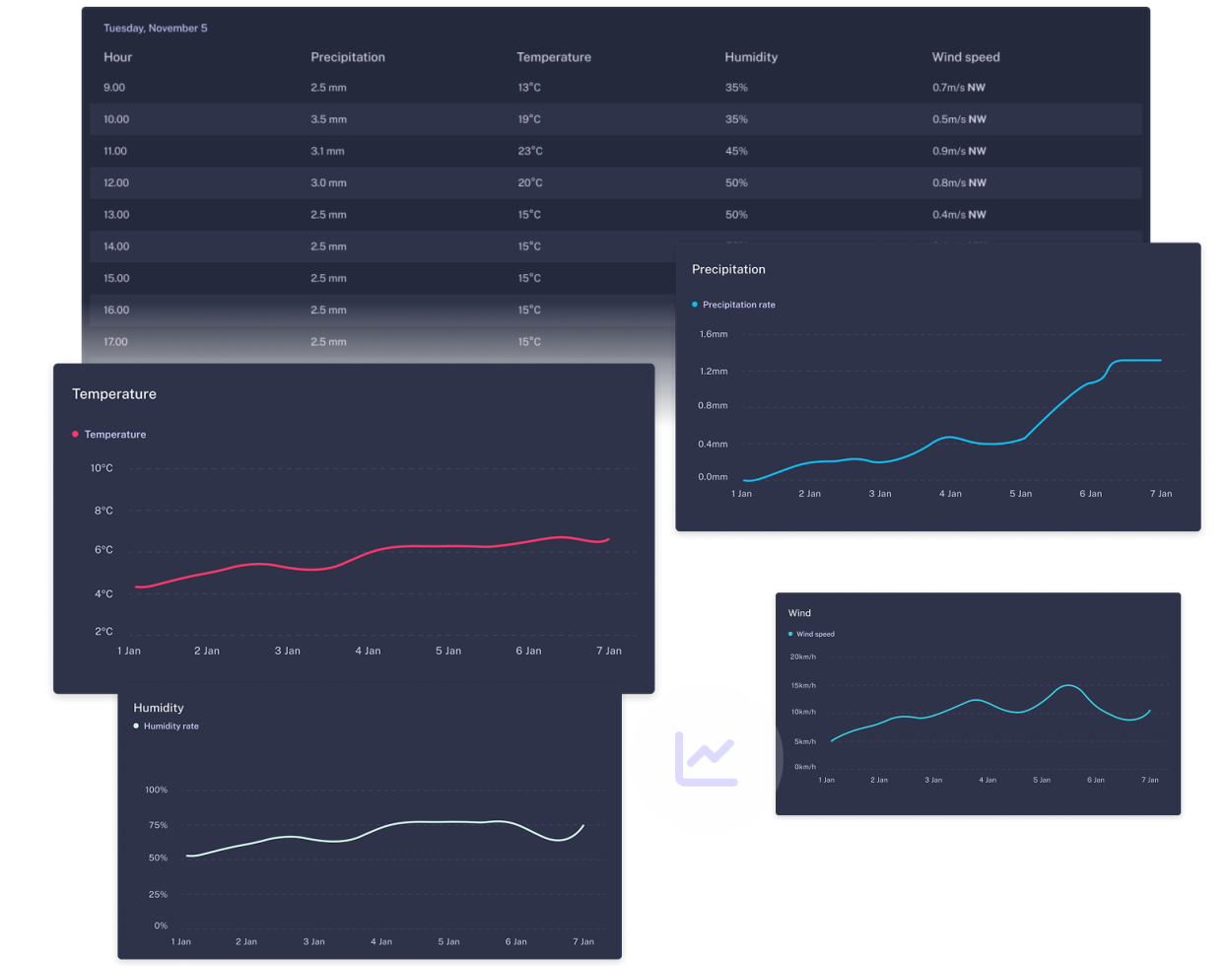
Evaluate WeatherXM Forecasts & Datasets
Access historical forecast accuracy benchmarks, subscribe to HSF hyperlocal station forecasts, or build algorithmic energy trading models with WeatherXM Pro.